Classic Hot Dog Condiments Ranked and Reviewed
There are foods that invite customization, and then there is the hot dog, which almost demands it. A plain dog in a bun has its own modest appeal, especially straight off a charcoal grill with a blistered casing and a soft, slightly steamy roll. But condiments are what turn it from serviceable to memorable. They change the balance of fat, salt, smoke, sweetness, acidity, and heat in a matter of seconds. They can rescue a dry dog, sharpen a rich one, or ruin the whole thing if they are applied without judgment.
Ranking classic hot dog condiments is tricky because context matters. A snappy all-beef frank on a griddled bun behaves differently from a softer, milder pork-and-beef dog at a backyard cookout. Some condiments shine on a stadium-style steamed dog. Others need the char and bitterness of an open flame. Some belong in restraint, a thin stripe or spoonful. Others are capable of carrying the entire bite.
What follows is a practical ranking, based on flavor, versatility, texture, and how reliably each condiment improves a hot dog rather than simply changing it. These are the standards most people actually reach for, not regional one-offs or chef-driven toppings. Every pick here has a place. The ranking reflects how often each one delivers.
What makes a hot dog condiment worth using
A strong condiment does at least one of three things well. It cuts richness, adds contrast, or deepens the savory profile without overwhelming the dog itself. The best ones can do two jobs at once. Mustard, for example, adds acidity and spice. Sauerkraut brings sharpness and texture. Chili adds heft and warmth, but only if it is not so wet that it drowns the bun.
Texture matters more than people admit. Hot dogs are inherently soft in several directions. Even a well-snapped casing gives way quickly. The bun is tender. Many condiments are smooth. That means a topping with crunch, shredded structure, or grain can make the whole thing feel more alive. This is one reason chopped onion remains so effective, even in tiny quantities.
Temperature matters too. Cold relish on a hot dog can be excellent. So can warm chili. But a cold, stiff slice of cheese laid on top and left unmelted often creates a disconnected bite. The great condiments meet the hot dog where it is.
No. 7: ketchup
Ketchup ranks last not because it is terrible, but because it is limited. On the right hot dog, especially a basic grilled frank at a family cookout, ketchup can work. Its sweetness is familiar, its acidity is gentle, and its smooth texture spreads evenly without effort. Children tend to like it because it rounds off smoke and salt. Plenty of adults do too, whether or not they admit it when someone starts making rules about proper toppings.
The problem is that ketchup rarely improves a good hot dog as much as the alternatives do. It tends to flatten rather than sharpen. The sugar can mask the flavor of a better-quality frank. On a heavily charred dog, that sweetness can be useful. On a milder, steamed dog, it often turns the whole thing soft and sugary.
Ketchup also struggles in combinations. Paired with mustard, it can be fine, though often messy and a little generic. Paired with relish, it can become candy-like. Paired with sauerkraut or https://rentry.co/v844k77r onions, it frequently muddies their sharper edges. There is nothing offensive about ketchup on a hot dog, but there is usually a more interesting choice available.
Its best use is as a small supporting stripe on a simple dog when you want comfort more than complexity. Used sparingly, it can evoke ballparks, paper plates, and summer evenings. Used heavily, it tastes like surrender.
No. 6: yellow mustard
This will irritate some purists, but yellow mustard lands in the lower middle, not near the top. It is iconic, affordable, and better than ketchup on most hot dogs. It brings acid, a touch of heat, and that unmistakable bright, almost fluorescent personality that belongs at carnivals, little league fields, and old lunch counters. A plain hot dog with yellow mustard is never embarrassing.
Still, yellow mustard is not always the best mustard. Its flavor is blunt by design. That bluntness is part of its charm, yet it can dominate more delicate dogs and clash with premium franks that have stronger garlic, smoke, or beef notes. If you have ever put cheap yellow mustard on a really good natural-casing dog and felt that something got lost, you were not imagining it.
What keeps it ahead of ketchup is utility. Yellow mustard cuts fat better, plays more nicely with onions and relish, and gives the bite definition. On a steamed bun and a basic beef frank, it is reliable. On a hot dog that came off a charcoal grill with deep blistering, it wakes everything up.
There is also a practical advantage. Yellow mustard has ideal hot dog viscosity. It pipes on cleanly, stays where you put it, and does not soak the bun. That sounds small until you have watched a watery condiment turn the lower half of the roll into paste.
If you grew up eating hot dogs at church picnics, school concession stands, or county fairs, yellow mustard probably lives in your memory as the default. That counts for something. Familiarity is not excellence, but it is not nothing either.
No. 5: sweet pickle relish
Relish earns its place because it solves problems other condiments cannot. It adds sweetness, yes, but it also contributes chopped texture, mild acidity, and a cool contrast that can make a hot dog feel less one-note. On a very salty dog, relish is a relief. On a plain beef frank with mustard, it creates one of the classic American combinations for good reason.
The best sweet pickle relish has discernible bits of cucumber and a bright vinegary snap beneath the sugar. The worst versions are fluorescent, syrupy, and so soft they may as well be jam. Quality matters here more than people realize. A decent relish tastes fresh and lively. A bad one tastes shelf-stable in the least flattering way.
Relish also has a placement issue. Too much and it slides. Too little and it disappears. The sweet spot is a narrow line down the center or a modest spoonful nestled under mustard. Applied with some restraint, it makes a hot dog more dimensional. Applied carelessly, it turns each bite into a wet sugar-vinegar mash.
It pairs especially well with yellow mustard because the two condiments correct each other. Mustard brings edge. Relish softens it. Relish brings sweetness. Mustard prevents that sweetness from taking over. On their own, both are simpler. Together, they feel complete.
Still, relish rarely leads. It is most effective as part of a duo, occasionally a trio. That keeps it out of the top tier.
No. 4: chopped onions
Onions are one of the most underappreciated hot dog condiments because they do not announce themselves the way mustard or chili do. Yet from a technical standpoint, they are brilliant. They bring crunch, bite, moisture, and aromatic sharpness without coating the dog. Instead of blanketing the frank, they punctuate it.
Raw white onions are the classic choice, and for good reason. Their clean heat cuts through fat immediately. A tablespoon scattered over mustard creates contrast in every bite. On a steamed dog, they provide structure. On a grilled dog, they accent the smoke rather than competing with it.
Finely chopped onions from a pushcart have a particular magic. They are usually a little wetter than home-diced onions, a little tamer, and somehow exactly right once they hit a hot dog with mustard. Many home cooks chop onions too large for the task. Big chunks make the bite awkward. A hot dog wants small pieces that distribute easily and stay in place.
Onions do carry risk. Raw onion can dominate if the dog is mild or the dice is too heavy-handed. Their heat lingers on the breath. They can spill everywhere. But no other classic condiment does so much with so little. If I had to rescue a bland hot dog with just one supporting topping, beyond mustard, chopped onions would be near the top of the list.
They also adapt. Raw onions are traditional, but lightly griddled onions can be excellent on a richer dog, especially when paired with mustard or chili. That flexibility keeps them competitive even against flashier options.
No. 3: sauerkraut
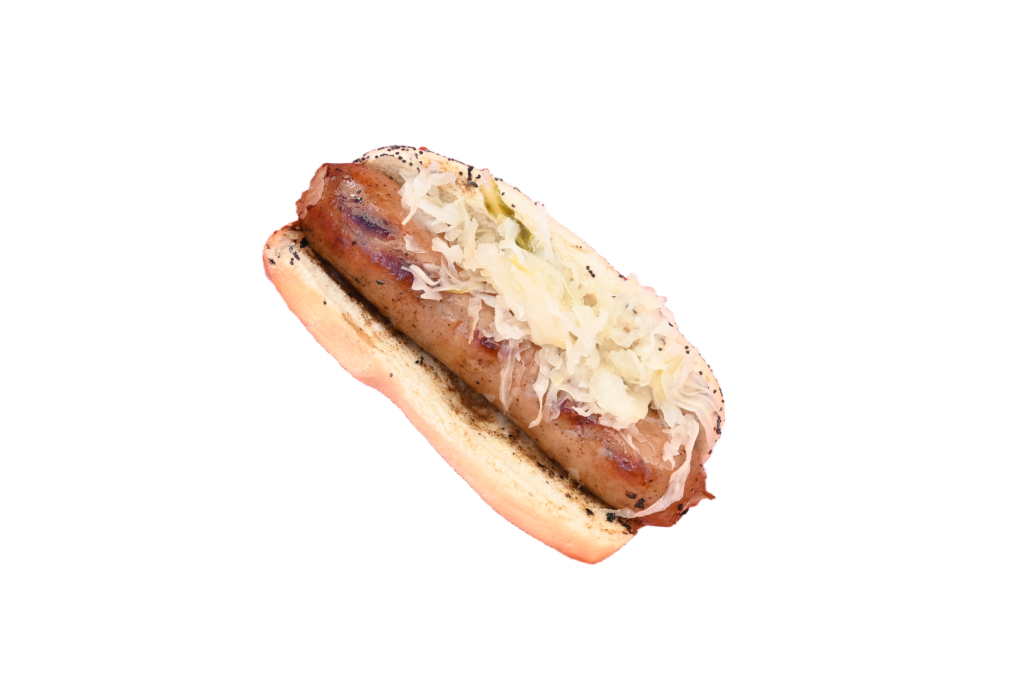
A good hot dog with sauerkraut tastes like someone thought carefully about balance. The dog brings salt, fat, and smoke. The kraut answers with acid, funk, and shredded texture. When it is done well, the combination feels inevitable.
Sauerkraut’s strength is seriousness. It turns a casual hot dog into something with backbone. It is especially effective on all-beef franks, where the lactic tang and soft crunch offset the richness beautifully. Add mustard and the bite gains both vertical and horizontal range, sharp up front, savory in the middle, clean at the finish.
A lot depends on the kraut itself. Cheap sauerkraut can be limp, overly sour, or metallic from the can or jar. Better kraut has strands that still hold shape and a balanced fermentation, tart but not punishing. Warming it gently helps. Ice-cold kraut straight from the fridge can mute the dog and shock the bun. Slight warmth lets it settle into the frank rather than sitting on top like an afterthought.
Sauerkraut is not the most universally loved condiment, which keeps it from taking the top spot. Its fermented character is too aggressive for some eaters. It also does not pair naturally with sweet toppings, and it can be cumbersome at casual gatherings where people are juggling paper plates and standing up.
Even so, when the hot dog is good and the kraut is treated properly, this is one of the most satisfying classic combinations on the table. It tastes adult without being fussy. It tastes old-school in the best sense.
No. 2: chili
Chili changes the category. A hot dog with mustard is still basically a dressed hot dog. A hot dog with chili becomes a meal, or at least acts like one. It adds weight, warmth, spice, and savory depth. It also creates a sense of indulgence that no cold condiment can quite match.
The key distinction is that hot dog chili is not simply a bowl of chili dumped on a frank. The best versions are finer in texture, less bean-heavy or bean-free depending on local tradition, and cooked to a spoonable consistency that clings instead of running. Good hot dog chili should drape over the dog, not flood the bun. That line matters. Too loose and every bite collapses into wet bread. Too thick and it sits there like meat paste.
When chili works, it is spectacular. The hot dog gets buried just enough to become richer, more savory, and more substantial. Add chopped onions and a streak of mustard and you have a combination with real architecture. Soft bun, meaty dog, warm chili, sharp onion, acidic mustard. It is messy, yes, but the mess means something.
Chili loses the top spot because it is not as versatile. It is too much for certain settings, especially a quick lunch or a hot summer afternoon. It can overpower a premium frank. It demands napkins and, in many cases, a fork. It also varies wildly in quality. Great chili dogs are unforgettable. Bad ones are gluey, greasy, and exhausting by the halfway point.
Still, judged on pleasure alone, chili is hard to beat. There is a reason chili dogs inspire regional loyalty and late-night devotion. When you want a hot dog that eats bigger than it looks, nothing else comes close.
No. 1: deli-style brown mustard
The top spot goes to brown mustard, sometimes labeled spicy brown, deli mustard, or coarse ground, depending on the brand and style. It does everything a great hot dog condiment should do. It cuts fat with real authority. It adds texture from the ground seeds. It brings a deeper, more rounded mustard flavor than yellow mustard. Most importantly, it improves nearly every hot dog it touches without stealing the show.
Brown mustard tastes like an adult refinement of yellow mustard’s best qualities. It still has brightness, but there is more complexity behind it, more warmth, more earthy pungency, more staying power. On an all-beef frank, it is almost unfair how naturally it fits. The spice wakes up the meat. The vinegar trims the richness. The grain gives subtle texture. It makes the dog taste more like itself, not less.
It is also the most adaptable condiment in this ranking. Brown mustard works alone. It works with onions. It works with sauerkraut. It works with relish, if you like a sweeter profile. It even works with chili, provided the chili is not overly seasoned. Few condiments can claim that range.
There is a sensory detail that often gets overlooked. Brown mustard lingers in a good way. After the first bite, there is a little warmth in the nose, a little tang on the tongue, a little bitterness that keeps the next bite interesting. That persistent edge is what separates excellent hot dog condiments from merely pleasant ones.
At delis and better sausage counters, brown mustard is often the first thing I reach for because it asks so little and gives so much. If the dog is excellent, brown mustard honors it. If the dog is ordinary, brown mustard elevates it. That is the mark of a number one condiment.
The pairings that outperform any single topping
Although this ranking treats condiments individually, hot dogs often peak in combinations. Not every famous pairing deserves its reputation, but a few are consistently better than the sum of their parts.
Here are the combinations that most often justify themselves:
- Brown mustard and chopped onions, the cleanest, sharpest, most balanced classic pairing.
- Yellow mustard and sweet relish, ideal on a simple grilled hot dog at a cookout.
- Brown mustard and sauerkraut, especially strong on all-beef or natural-casing franks.
- Chili and onions, the richest option, best when you want the hot dog to eat like a full meal.
- Chili, onions, and mustard, the maximalist version, messy but deeply satisfying when properly proportioned.
The pattern is straightforward. A great pairing combines richness with acid, softness with texture, and familiarity with just enough friction to keep the bite lively.
A few hard-earned rules for dressing a hot dog well
Anyone who has served hot dogs for a crowd learns quickly that condiments are less forgiving than they seem. The difference between a great dog and a sloppy one often comes down to proportion.
A hot dog should still taste like a hot dog. That sounds obvious, but it is easy to forget when piling on chili, kraut, or half a cup of onions. The frank needs room to speak. Condiments are seasoning and structure, not camouflage.
The bun deserves protection. Wet condiments should go in measured amounts, and if possible, closer to the center than the edges. If you are using sauerkraut or chili, a lightly toasted or griddled bun buys you extra resilience. A steamed bun can be lovely with mustard and onions, but it folds fast under heavier toppings.
Think in contrasts, not quantity. If your hot dog is deeply charred and smoky, you probably want acid and crunch. If it is soft and mild, you might want spice or savoriness. Sweetness has its place, but too much sweetness dulls the whole experience.
And be honest about the dog itself. A cheap supermarket frank often benefits from louder condiments. A high-quality butcher dog or natural-casing all-beef frank usually needs less interference. One of the easiest mistakes people make is treating every hot dog like the same blank canvas.
The final ranking at a glance
For quick reference, the order stands as follows:
- Deli-style brown mustard
- Chili
- Sauerkraut
- Chopped onions
- Sweet pickle relish
Yellow mustard and ketchup round out the lower positions just behind them, useful and familiar, but less consistently impressive.
That ranking may shift slightly depending on region, nostalgia, and what kind of hot dog is in front of you. A ballpark dog can make yellow mustard feel unbeatable. A chili dog from a roadside stand can flatten every abstract argument about elegance. But if the test is which classic condiment most reliably makes a hot dog better, brown mustard wins on flavor, flexibility, and restraint.
The beauty of the hot dog, after all, is not that there is one correct way to dress it. It is that small decisions matter. A spoonful of kraut, a stripe of mustard, a pinch of onions, and suddenly a very simple food has personality. That is why people keep debating condiments long after the grill cools down. The argument is part of the meal.
Under Construction Hot Dogs
1225 W U.S. Hwy 50, Pueblo, CO 81008
FAQ About hot dog
What are different types of hotdogs?
Under Construction Hot Dogs offers a classic all-beef hot dog, a quarter-pound Jumbo Dog, a Chili Dog, and a Chicago Dog, along with brats and a Spicy Link.
What does a chili dog have on it?
Our Chili Dog pairs a Vienna all-beef hot dog with chili, shredded cheddar cheese, and finely diced onions.
What is in a traditional Chicago dog?
Our Chicago Dog comes on a steamed poppy seed bun with yellow mustard, bright green relish, onions, tomato wedges, a pickle spear, sport peppers, and celery salt.